If you are a young person stepping into the workforce, an aspiring lawyer, or just a citizen wanting to understand your rights, there is one legal case you must know. It is the judicial equivalent of an earthquake. It rewrote the rules of the game for employers and employees across India.
That case is Bangalore Water-Supply & Sewerage Board vs. R. Rajappa & Others (1978).
Spanning over 80 pages of complex jurisprudence, this 1978 Supreme Court judgment, delivered by a massive 7-Judge Bench, answered one deceptively simple question: What exactly is an "Industry"?
Why does this matter? Because if your workplace is legally classified as an "industry" under the Industrial Disputes (ID) Act, 1947, you are protected by a fortress of labor laws. You get rights against unfair dismissal, mechanisms to demand better wages, and the power to unionize. If your workplace is not an industry, you are largely left to fend for yourself under basic contract law.
Let’s tear down the legal jargon and explore this monumental judgment, exploring the history, the drama, the philosophy, and the final rules that still govern Indian labor law today.
Part 1: The Chaos Before the Storm (The Historical Context)
To understand why this case was so important, we have to look at the legal landscape before 1978. The Industrial Disputes Act of 1947 defined "industry" in Section 2(j).
The definition read:
"Industry means any business, trade, undertaking, manufacture or calling of employers and includes any calling, service, employment, handicraft, or industrial occupation or avocation of workmen."
Read that carefully. It is incredibly broad. It essentially says an industry is anything an employer does, and anything a workman does.
Because the definition was so vague, different judges interpreted it in wildly different ways over the decades. This led to a "zigzag course" of conflicting judgments.
- The Banerji Case (1953): Said municipalities doing public utility work were industries.
- Hospital Mazdoor Sabha (1960): Said government-run hospitals were industries.
- Safdarjung Hospital (1970): Overruled the above and said hospitals focused on research/training were not industries.
- Delhi University Case (1963): Ruled that universities were not industries because education is a "noble mission," not a business, and teachers aren't workmen.
- Gymkhana Club & Cricket Club of India (1968/1969): Ruled that elite members' clubs were not industries because they were "self-serving" pleasure institutions without a profit motive.
- Solicitors Case (1962): Ruled that a lawyer's office was not an industry because the work relied on the personal intellectual skill of the lawyer, not the cooperation of the clerks.
By the mid-1970s, Indian labor law was a tangled mess. A worker in a factory had rights, but a clerk in a university, a nurse in a hospital, or a waiter in an elite club did not. The law had created "islands of exception."
Enter the Bangalore Water-Supply case.
Part 2: The Facts of the Case
The facts that triggered this massive constitutional review were actually quite simple.
The Bangalore Water-Supply and Sewerage Board (the employer) fined some of its employees (the respondents, including R. Rajappa) for alleged misconduct and recovered money from their salaries.
The employees fought back. They filed a claim under Section 33C(2) of the Industrial Disputes Act before a Labour Court, arguing the punishment violated the principles of natural justice.
The Board raised a preliminary legal defense: "You cannot sue us under the Industrial Disputes Act because we are not an 'industry'. We are a statutory body performing a sovereign, regal function of the State (providing basic amenities like water to citizens)."
The Labour Court rejected this defense. The High Court of Karnataka also rejected it. Finally, the Board appealed to the Supreme Court. Recognizing that the definition of "industry" was broken and causing chaos across the country, the Supreme Court formed a massive 7-Judge Bench to settle the debate once and for all.
Part 3: The Philosophy of Justice Krishna Iyer
The majority judgment was authored by Justice V.R. Krishna Iyer, one of the most celebrated and progressive judges in Indian history. His approach to this case was deeply rooted in the Indian Constitution, specifically Part IV (Directive Principles of State Policy), which mandates social justice, fair labor conditions, and the protection of workers.
Justice Iyer refused to look at the word "industry" through the lens of traditional, capitalist, 19th-century British law. He noted that India is a developing, socialist-leaning republic.
His core philosophy in this judgment was:
- Worker-Centric Approach: The Industrial Disputes Act is a beneficial legislation meant to protect the weaker party (labor) and ensure industrial peace. Therefore, the definition of "industry" must be interpreted as broadly as possible.
- Eradicating Elitism: He aggressively criticized the previous judgments that exempted universities, clubs, and law firms. He saw this as "elitist professionalism" and "class snobbery"—an attempt by the privileged classes to keep labor unions out of their sanctified spaces.
- Modern Realities: In the modern world, services (like education, healthcare, and research) are just as much a part of the national economy as manufacturing steel or mining coal.
Part 4: The "Triple Test" (The Golden Rule)
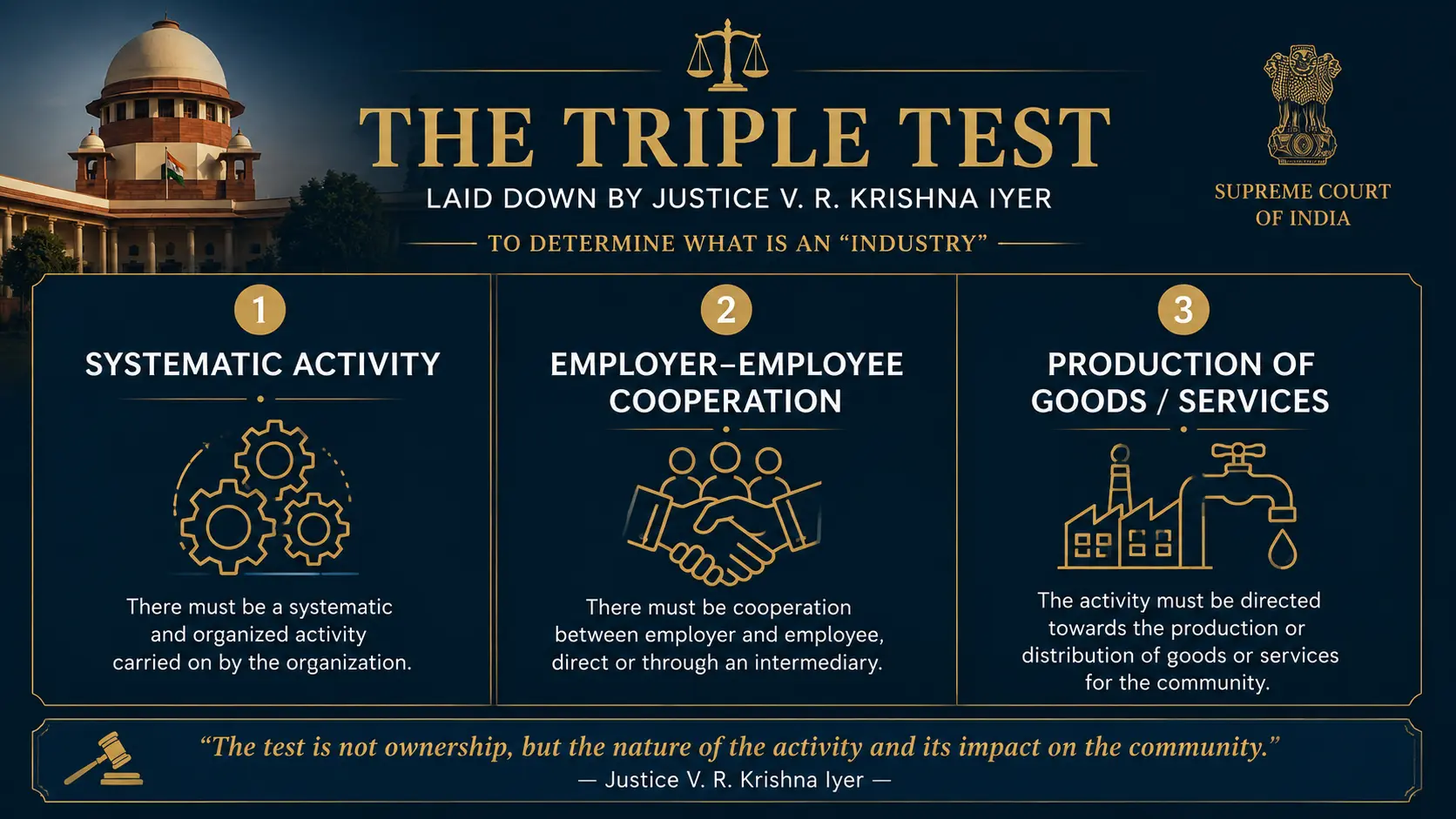
To clear up the confusion, Justice Krishna Iyer formulated a definitive, working formula to identify an industry. This is now famously known as the Triple Test.
For an enterprise to be considered an "industry" under the law, it must satisfy three criteria:
1. Systematic Activity
The activity cannot be a one-off, casual, or fleeting adventure. It must be organized, continuous, and systematic. A person cooking a meal for a friend once is not an industry. A restaurant cooking meals daily is.
2. Organized by Cooperation between Employer and Employee
There must be a relationship where an employer hires employees to work together to achieve a goal. Justice Iyer destroyed the old "direct nexus" theory (which argued that if an employee's work didn't directly produce the final intellectual product—like a clerk in a law firm—it wasn't an industry). He stated that everyone from the janitor to the CEO contributes to the success of the enterprise.
3. For the Production/Distribution of Goods and Services
The activity must satisfy material human wants and wishes. This includes not just physical goods (like cars or shoes) but also services (like education, healthcare, transportation, and entertainment). It does not include purely spiritual services (like seeking divine grace).
The Irrelevance of Profit and Charity
Justice Iyer added a massive caveat to the Triple Test:
- Profit Motive is Irrelevant: It does not matter if the enterprise makes millions in profit or runs on a "no-profit, no-loss" basis. The public sector is just as much an industry as the private sector.
- Charity is Irrelevant: Even if a business gives away its products for free to the poor, it is still an industry vis-a-vis its workers. The workers still need wages to feed their families; they are not doing charity.
Part 5: Busting the Myths (Bringing Sectors under the Act)
Applying the Triple Test, the Supreme Court systematically went through the "exempted" categories created by previous judgments and brought them crashing down into the realm of the Industrial Disputes Act.
A. Are Educational Institutions Industries? (YES)
Previously, the Delhi University case held that education was a "mission," not an industry, and teachers weren't workmen. Justice Iyer fiercely disagreed. Education, he noted, is the mother of all industries. It is a systematic activity where management (employer) and non-teaching/teaching staff (employees) cooperate to provide a vital service (education) to the community. He noted that modern education is highly commercialized, with massive administrative wings, transport fleets, and printing presses. Therefore, Universities and schools are industries.
B. Are Hospitals and Charitable Institutions Industries? (YES)
Overruling the Safdarjung case, the Court held that hospitals—whether run by the government, private corporations, or charities—are industries. They provide material services (healthcare) through the organized cooperation of doctors, nurses, sweepers, and administration. The fact that a hospital might treat the poor for free does not change the fact that its employees are working for wages and need labor protections.
C. Are Clubs Industries? (YES)
Previous courts exempted elite clubs (like the Gymkhana Club) because they were "self-serving" institutions for members. Justice Iyer mocked this. He pointed out that club members don't cook the food, clean the pools, or serve the drinks—hired workers do. Because there is an employer-employee relationship providing pleasurable services, clubs are industries.
D. Are Liberal Professions (Lawyers, Doctors, Architects) Industries? (YES)
The Court overruled the Solicitors Case. Justice Iyer noted that the "halo" around learned professions is a myth. A modern law firm or medical polyclinic is a humming economic engine. A lawyer cannot succeed without the typist, the librarian, and the clerk. Therefore, a professional firm operating with employees is an industry.
E. Are Research Institutes Industries? (YES)
Research involves the collaboration of scientists and support staff to discover new technologies or solutions, which are immensely valuable services to the community. Thus, they pass the Triple Test.
Part 6: The Exceptions (What is NOT an Industry?)
The Court did not say everything is an industry. They drew very specific lines to exclude certain activities.
1. Sovereign Functions (Stricto Sensu)
The government cannot be sued as an "industry" when it is performing strictly sovereign, inalienable functions. This is limited to:
- Maintaining Law and Order (Police)
- Administration of Justice (Courts)
- Defense of the Realm (Military)
- Legislative functions
However, if the government runs a bakery, a transport service, or a water-supply board, those are welfare/economic activities, not sovereign functions, and they are industries.
2. Purely Spiritual Institutions
If an Ashram or a monastery is run purely by devotees who work voluntarily for spiritual grace without the master-servant relationship or wage-earning expectations, it is not an industry. Even if they have one or two marginal paid sweepers, the core essence is non-economic.
3. Single-Person / Petty Professions
A rural doctor with one part-time assistant, a single lawyer working with a clerk, or a solitary cobbler on the street does not constitute an "industry." The Court noted that an industry requires a certain scale of "organized labor." The ID Act is meant to settle large-scale industrial friction, not meddle with a village blacksmith and his son.
Part 7: The Dominant Nature Test
What happens if an institution does multiple things? For example, what if a government department handles tax collection (sovereign function) but also runs a massive printing press (industrial function)?
The Court established the Dominant Nature Test.
- If an institution is a complex of activities, some industrial and some not, you must look at the predominant nature of the services.
- If the industrial units are substantially severable (meaning they can be looked at as a separate department), then the employees of that specific department will be protected by the ID Act, even if the larger umbrella organization is exempt.
Part 8: The Dissenting & Concurring Voices
While Justice Krishna Iyer’s judgment formed the majority (supported by Justices Bhagwati and Desai), it is vital to look at the other judges to understand the complexity of the case.
Chief Justice M.H. Beg
He concurred with the conclusion but wrote a separate opinion. He emphasized that the term "sovereign" is outdated in a modern Republic. He preferred the term "governmental functions." He agreed that the State stepping into commercial arenas cannot hide behind the shield of sovereignty to deny workers their rights.
Justice Y.V. Chandrachud (Concurring in part, dissenting in part)
He agreed that hospitals and clubs are industries. However, he expressed deep frustration that the judiciary was being forced to define something that the Parliament should have clearly legislated. He strongly disagreed with the exception of "sovereign functions." He argued logically: If making coins or bullets is an industry when done by a private person, why does it stop being an industry just because the State does it? The nature of the activity should matter, not who is doing it.
Justices Jaswant Singh and Tulzapurkar (The Dissent)
They felt Justice Iyer’s definition was too wide. They argued that "liberal professions" (lawyers, doctors) and charities should not be considered industries. They believed that in professions, the end product is the fruit of the professional's personal intellect, and the marginal contribution of a typist or clerk does not make it an industrial partnership. They pleaded for the Legislature to step in and clear the fog.
Part 9: Conclusion and Legacy
The Supreme Court ultimately dismissed the appeal of the Bangalore Water-Supply and Sewerage Board, holding that they were an industry and the employees had the right to sue them under the Industrial Disputes Act.
Why Does This Matter Today?
The Bangalore Water-Supply judgment remains the bedrock of Indian labor jurisprudence. By expanding the definition of "industry" to its absolute limits, the Supreme Court cast a protective net over millions of workers in hospitals, schools, clubs, NGOs, and professional firms who would otherwise have been left at the mercy of their employers.
As you navigate the modern workforce—whether you are joining a tech startup, an educational NGO, a corporate law firm, or a research lab—it is this 1978 judgment that ensures your right to fair wages, safe working conditions, and legal recourse against unfair termination.
It taught us a vital lesson: In a democracy, the law must evolve to protect the vulnerable. The dignity of labor does not vanish just because the workplace is a hospital instead of a factory. Work is work, and workers' rights are human rights.