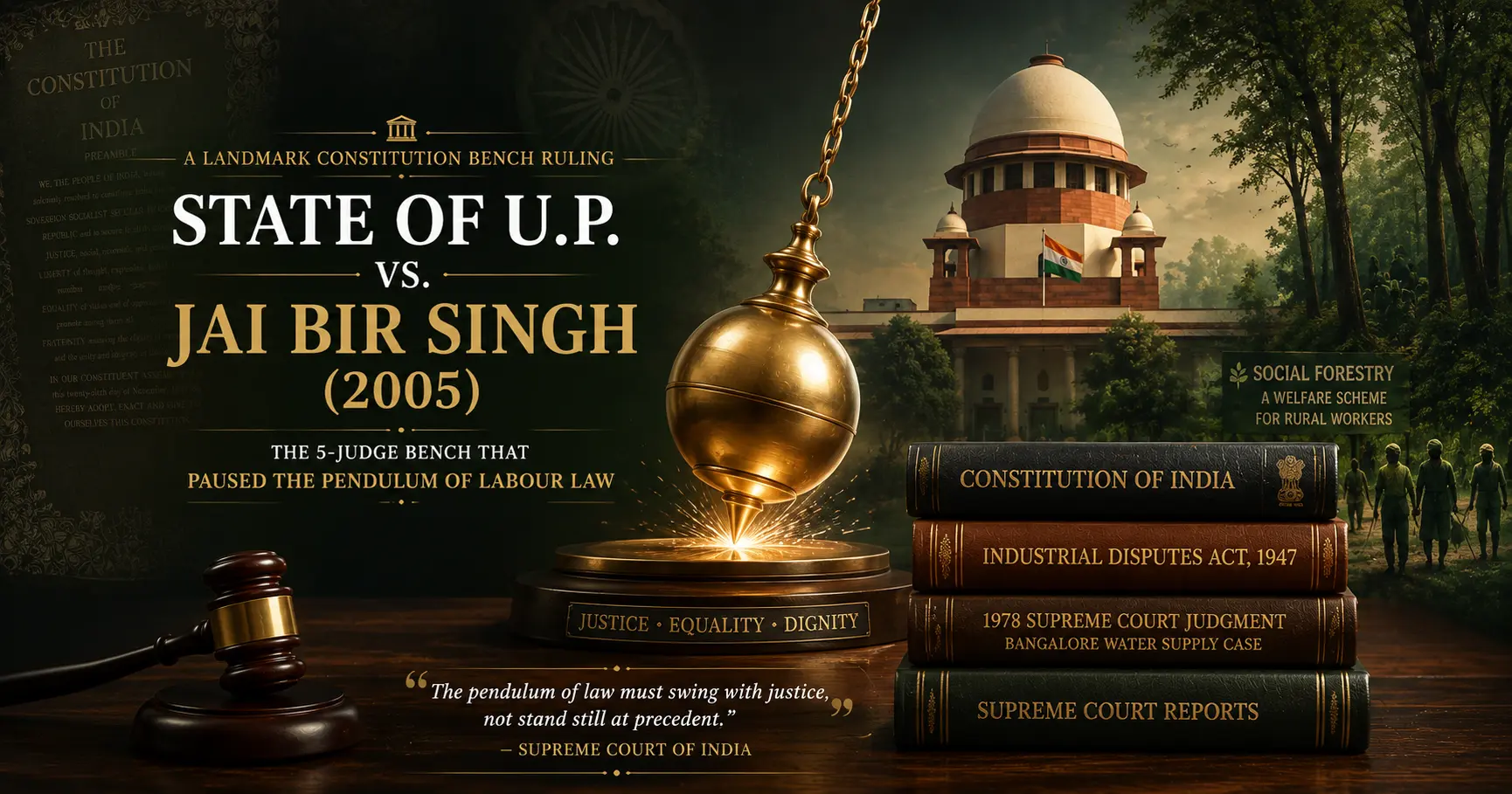
The interpretation of the word "Industry" under Section 2(j) of the Industrial Disputes Act, 1947, is perhaps one of the most litigated and debated concepts in Indian legal history. For decades, courts have swung like a pendulum between protecting the rights of vulnerable workers and safeguarding the economic viability of employers.
In 1978, the Supreme Court delivered the historic Bangalore Water Supply and Sewerage Board vs. A. Rajappa judgment. Authored largely by Justice V.R. Krishna Iyer, this 7-Judge Constitution Bench ruling radically expanded the definition of an industry. By formulating the famous "Triple Test," the Court effectively brought hospitals, educational institutions, research labs, charities, and clubs under the strict purview of labor law, prioritizing social justice over technicalities.
However, laws cannot exist in a vacuum, and interpretations must withstand the test of time. By 2005, the socio-economic realities of India had shifted. Enter the monumental 5-Judge Constitution Bench case: State of U.P. vs. Jai Bir Singh. Authored by Justice D.M. Dharmadhikari, this judgment pulled the emergency brake on the expansive 1978 precedent, arguing that an overly "worker-oriented" approach was inadvertently harming the economy and stifling private enterprise.
The Spark: Is "Social Forestry" an Industry?
The immediate catalyst for the Jai Bir Singh case was an apparent conflict between two smaller benches of the Supreme Court regarding the exact nature of the Social Forestry Department of the State.
- The 1996 View: In Chief Conservator of Forests v. Jagannath Maruti Kondhare, a 3-Judge bench relied on the 1978 Bangalore Water case and concluded that the Social Forestry Department is covered by the definition of an "industry."
- The 2001 View: In State of Gujarat v. Pratamsingh Narsinh Parmar, a 2-Judge bench took a contrary view, arguing against treating such welfare schemes as commercial industries.
Social forestry is essentially a welfare scheme undertaken by the government to improve the environment, plant trees, and maintain ecological balance. The legal dilemma was profound: Should a purely environmental welfare scheme run by the State be treated as a commercial "industry"? If classified as an industry, the workers employed in planting trees could unionize, strike, and demand heavy back-wages under the Industrial Disputes Act, potentially paralyzing the State's environmental efforts.
Recognizing the severity of this conflict and the underlying tension with the 1978 precedent, the matter was placed before a 5-Judge Constitution Bench to settle the debate.
The 23-Year Legislative Paralysis
One of the most fascinating aspects of the Jai Bir Singh judgment is its commentary on legislative and executive inaction. Even back in 1978, the judges recognized that their expansive definition of "industry" was a temporary, judge-made solution to a vague law. They actively urged the Parliament to step in and clarify the law.
The 1982 Amendment Act
Parliament did respond. In 1982, the Industrial Disputes (Amendment) Act was passed. It provided a much tighter, redefined version of "industry," explicitly taking out hospitals, educational institutions, charities, and sovereign governmental activities from its purview.
However, there was a catch. Section 1(2) of the Amendment Act required the Central Government to issue a notification in the Official Gazette to bring these new provisions into force. Shockingly, for 23 years, this notification was never issued.
When questioned in a previous case (Aeltemesh Rein v. Union of India, 1988), the Union Government explained that if they excluded these institutions from the ID Act, the employees would have no alternative machinery to redress their grievances. Therefore, they withheld the notification.
The 2005 Bench noted this with immense frustration. Because the Executive refused to enforce the law passed by Parliament, the courts were forced to continue applying the expansive, outdated, and heavily criticized 1978 interpretation for nearly a quarter of a century.
Critiquing the 1978 Bangalore Water Legacy
Justice Dharmadhikari did not hold back in dismantling the flaws of the 1978 Bangalore Water Supply case. The 2005 Bench outlined three major critiques that necessitated a fresh review of the law:
1. The Fractured Mandate (Lack of Unanimity)
The Court pointed out that Bangalore Water was not a unanimous, cohesive decision. While Justice Krishna Iyer delivered the main opinion (for himself and two others), Chief Justice Beg wrote a separate opinion on his last working day, explicitly dissenting on the narrow interpretation of "sovereign functions."
Furthermore, Justice Chandrachud wrote his opinion weeks later, and Justices Jaswant Singh and Tulzapurkar filed a sharp dissenting opinion regarding the inclusion of charities and liberal professions. Because the judges had not fully read each other's opinions before delivery, the 2005 Court questioned whether Justice Iyer’s opinion could be treated as an absolute, unassailable binding precedent.
2. The Economic Hazard of Over-Protection
The 2005 judgment took a highly pragmatic, socio-economic view. The Court observed that the experience of the last two decades under the 1978 regime was "not entirely happy."
"Industrial awards granting heavy packages of back wages, sometimes result in taking away the very substratum of the industry. Such burdensome awards in many cases compel the employer having moderate assets to close down..."
By over-emphasizing workers' rights, the 1978 interpretation severely curtailed the rights of employers. The Court noted that forcing an employer to pay idle wages (back-wages) to a worker while an adjudication dragged on for years acted as a serious industrial hazard, ultimately harming the general public who rely on the industry's goods and services.
3. The Threat to Self-Employment (Liberal Professions)
The 1978 ruling dragged "liberal professions"—like lawyers, doctors, architects, and chartered accountants—into the definition of an industry if they hired a few clerks or assistants. The 2005 Bench argued that these professions are based on personal talent, skill, and intellectual attainment. Treating them as commercial industries serves as a massive hurdle, deterring private enterprise and self-employment in a country where public jobs are critically scarce.
Redefining "Sovereign Functions" in a Welfare State
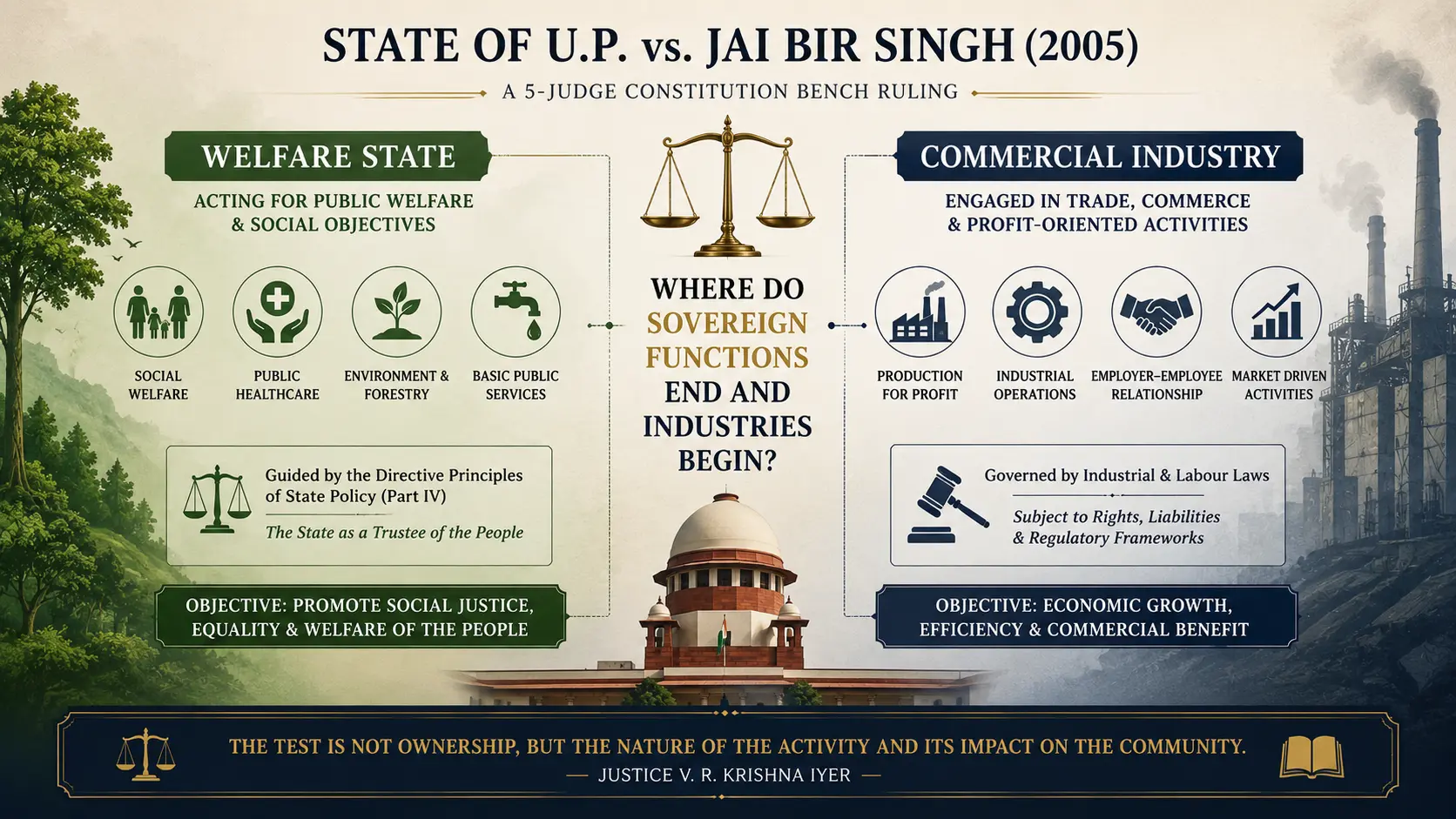
One of the most profound legal shifts proposed by Jai Bir Singh concerns the concept of "Sovereign Functions."
In the 1978 case, Justice Iyer limited the exemption of sovereign functions to "inalienable functions" traditionally performed by a monarch or colonial ruler—specifically police (law and order), defense, legislation, and justice dispensation. Everything else the government did was considered an "economic adventure" or industry.
The 2005 Paradigm Shift
Justice Dharmadhikari entered a strong caveat against this outdated colonial view. In a modern constitutional democracy, sovereignty vests in the people. The State is constitutionally obliged by the Directive Principles of State Policy (Part IV of the Constitution) to undertake massive public welfare activities.
Therefore, whenever the government undertakes public welfare activities (like social forestry, free healthcare, or public education) to discharge its constitutional obligations, these activities must be treated as sovereign functions. They belong outside the purview of commercial "industry" and industrial disputes.
The Final Verdict: A Call for a Larger Bench
The 2005 Bench recognized that industrial law must harmonize the relationship between the employer (who invests capital), the employee (who contributes labor), and the public (the ultimate beneficiary). A one-sided ideological approach based purely on Karl Marx's philosophy of class struggle—which the court hinted influenced the 1978 ruling—was deemed inappropriate for India's pluralist, democratic society.
The Court stated:
"A worker-oriented approach in construing the definition of industry, unmindful of the interest of the employer or the owner of the industry and the public who are ultimate beneficiaries, would be a one-sided approach..."
Because the 1978 Bangalore Water Supply case was decided by a 7-Judge Constitution Bench, the 5-Judge bench in Jai Bir Singh lacked the jurisdictional authority to overrule it directly.
Therefore, the Court directed the matter to the Chief Justice of India to constitute a suitable larger Bench (of 7 or 9 judges) to reconsider the 1978 judgment, redraw the lines fairly, and correct the course of Indian labor jurisprudence once and for all.