Contact Us
YC
Youth Connect Legal

Table of Contents

Disclaimer

As per BCI rules, we do not solicit work or advertise. Information is educational and obtained at user volition.

SM

SM & Associates

Shikhar Mall

Educational legal analysis.

smandassociates2026@gmail.com
The Landmark Expansion

Bangalore Water-Supply
vs. A. Rajappa

Supreme Court of India (1978) - 7 Judge Bench

Established the Triple Test, massively expanding the definition of "Industry" to include hospitals, clubs, universities, and charities, ignoring profit motives.

The Pushback & Review

State of U.P.
vs. Jai Bir Singh

Supreme Court of India (2005) - 5 Judge Bench

Criticized the 1978 ruling for being too "worker-oriented" and harming the economy. Suggested that welfare schemes (like Social Forestry) and liberal professions should be exempt from labor disputes.

Critical Synthesis

The Pendulum of Industrial Jurisprudence

Tracking the ideological shift from 1978 to 2005.

2005 Legal Analysis

Decoding State of U.P. vs. Jai Bir Singh (2005): A Turning Point

Introduction: The Need for Course Correction

For nearly three decades, Indian labor law was governed by the monumental 1978 judgment of Bangalore Water Supply. It radically expanded the definition of an "industry" under Section 2(j) of the Industrial Disputes Act, 1947. However, in 2005, a 5-Judge Constitution Bench pulled the emergency brake, systematically dismantling the flaws of the 1978 ruling.

The Spark: Is "Social Forestry" an Industry?

The immediate trigger was whether a purely environmental welfare scheme (Social Forestry) run by the State should be treated as a commercial "industry". The 2005 bench recognized that treating welfare schemes as commercial industries where workers can strike and demand heavy back-wages was suffocating the State's ability to help its citizens.
The Final Escalation

The 9-Judge Reference: State of U.P. v. Jai Bir Singh (2017)

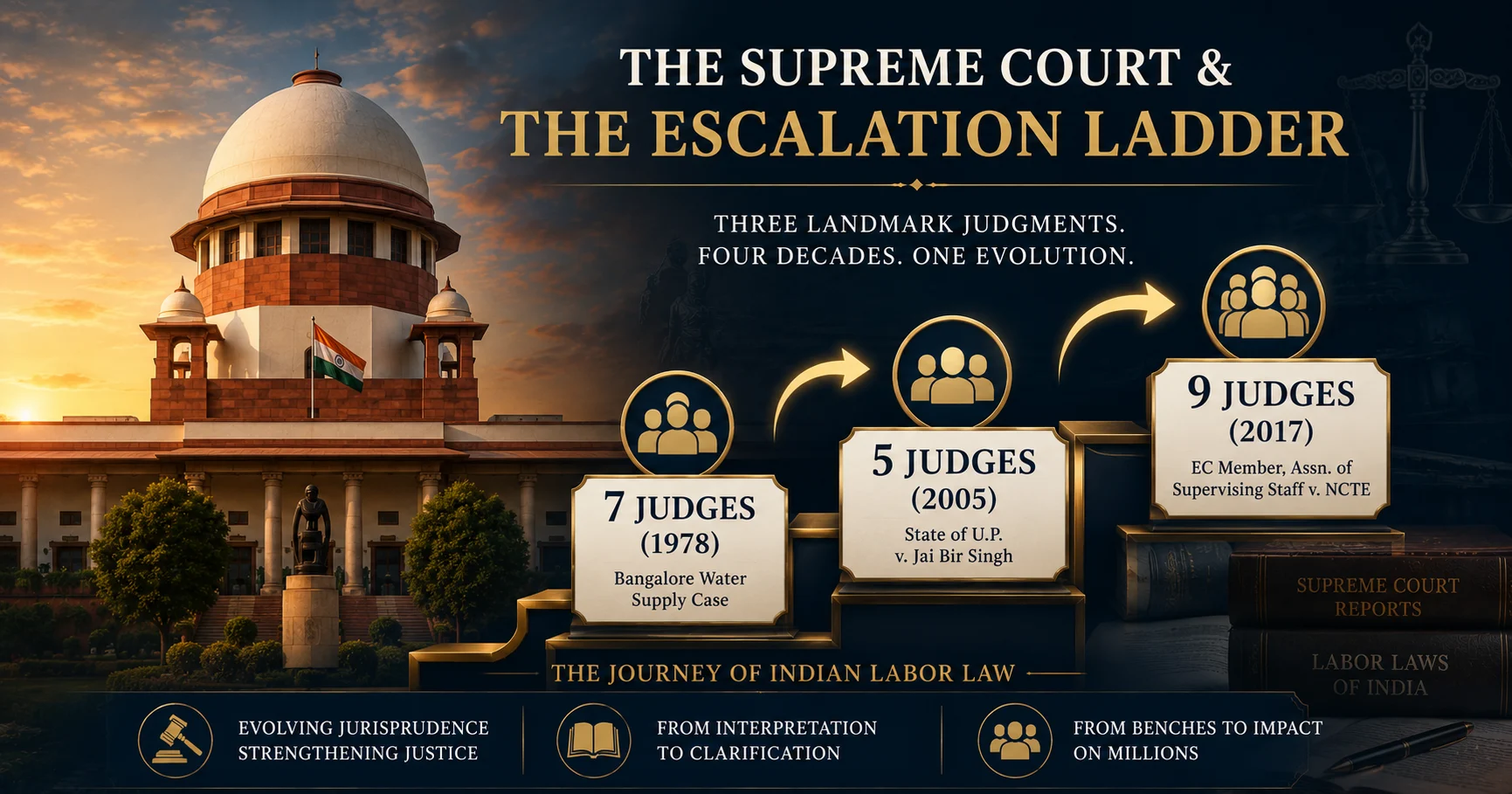
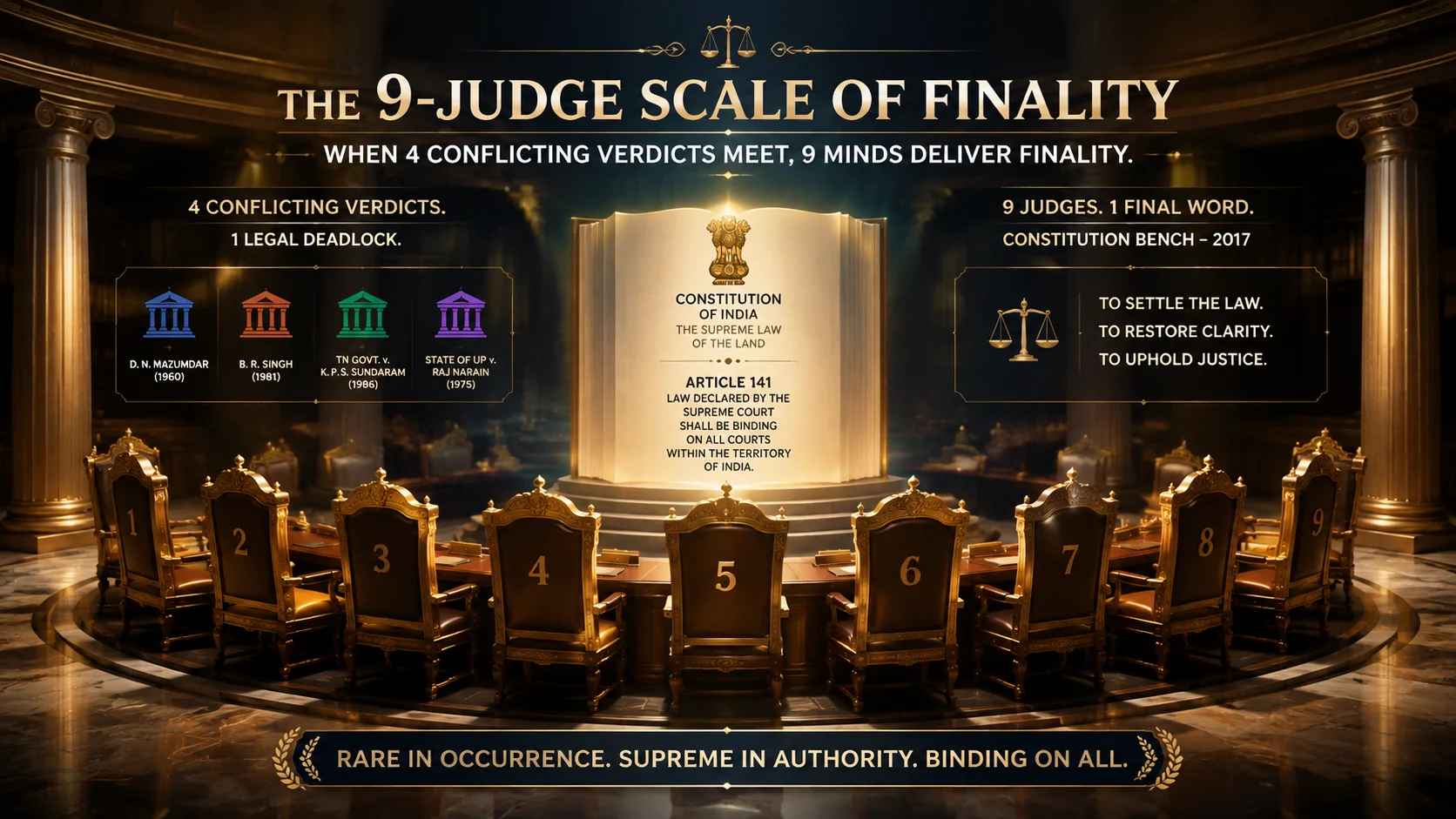
How a 7-Judge Supreme Court Bench elevated the decades-old debate over the definition of "Industry" to an ultra-rare 9-Judge Constitution Bench.

Evolution of Indian Labor Law Hero Banner

1. The Journey from 1978 to 2017: Connecting the Code

To understand the 2017 Supreme Court Order, we must trace the legal code—specifically Section 2(j) of the Industrial Disputes Act, 1947. The definition of "Industry" in this code was incredibly vague.

In 1978 (Bangalore Water Supply), a 7-Judge bench interpreted this code as expansively as possible, protecting millions of workers in hospitals, clubs, and universities. Reacting to this, Parliament passed the 1982 Amendment Act to rewrite the code and exclude these institutions. However, the Executive branch never notified the amendment. The new code remained dormant, and the 1978 interpretation ruled by default.

In 2005 (Jai Bir Singh), a 5-Judge bench recognized the severe economic damage caused by the 1978 interpretation. They pleaded for a balanced approach that protected employers and the state's sovereign welfare functions. But a 5-Judge bench cannot overrule a 7-Judge precedent. They could only refer it upward.

2. The 2017 Order: A Historic Judicial Escalation

On January 2, 2017, a massive 7-Judge bench headed by the Chief Justice of India, T.S. Thakur, alongside legal luminaries like Justice D.Y. Chandrachud and Justice S.A. Bobde, took up the 2005 reference.

The Exact Words of the Court:

"Having given our anxious consideration to the contentions urged at the bar and the serious and wide ranging implications of the issue that fall for determination as also the fact that serious doubts have been expressed in the reference order about the correctness of the view taken in Bangalore Water Supply’s case... we are of the opinion that these appeals need to be placed before a Bench comprising Nine-Judges."

This brief but monumental order acknowledged that defining the "code" of Indian Industry is not a minor task. The 1978 case had governed the nation for nearly 40 years. To uproot it required absolute, unassailable judicial authority.

3. The Mechanics of Precedent: Why 9 Judges?

9-Judge Constitution Bench

The Supreme Court operates on the doctrine of binding precedent. A smaller bench cannot overrule a larger bench.

  • The 1978 Case: Decided by 7 Judges.
  • The 2005 Case: Decided by 5 Judges. They criticized the 1978 case but were legally powerless to overturn it. They referred it upward.
  • The 2017 Case: Decided by 7 Judges. Theoretically, this 7-Judge bench could have attempted to modify the law. However, to ensure absolute finality, prevent future zigzagging, and comprehensively overwrite a 7-judge precedent, the Chief Justice deemed it necessary to escalate the matter to a 9-Judge Constitution Bench.

Frequently Asked Questions (2017 Order)

What exactly did the 2017 order decide?
The 2017 order did not change the substantive law itself. Instead, it was a procedural escalation. A 7-Judge bench formally recognized that the 1978 definition of "Industry" was highly controversial and directed the Chief Justice to form a 9-Judge bench to finally resolve the dispute.
How does this connect to the previous 2005 judgment?
In 2005 (State of U.P. v. Jai Bir Singh), a 5-Judge bench strongly criticized the 1978 rules, stating they harmed the economy and misclassified sovereign functions. The 2017 case is the direct continuation of that 2005 case. The 7 judges in 2017 read the 2005 critiques, agreed they had "serious implications," and pushed the case to a 9-judge bench for a final verdict.
What is the current law until the 9-Judge bench decides?
Because the 1982 Amendment to the legal code was never enforced, and the 2005/2017 benches merely referred the matter upward without overruling it, the 1978 Bangalore Water Supply judgment technically remains the binding precedent until the 9-Judge Constitution Bench officially issues a new ruling.
Slide 1 of